
Between variety and precision: alternating solids production
An insight into solids production at KLOCKE Pharma-Service GmbH in Appenweier
A location that is designed for change
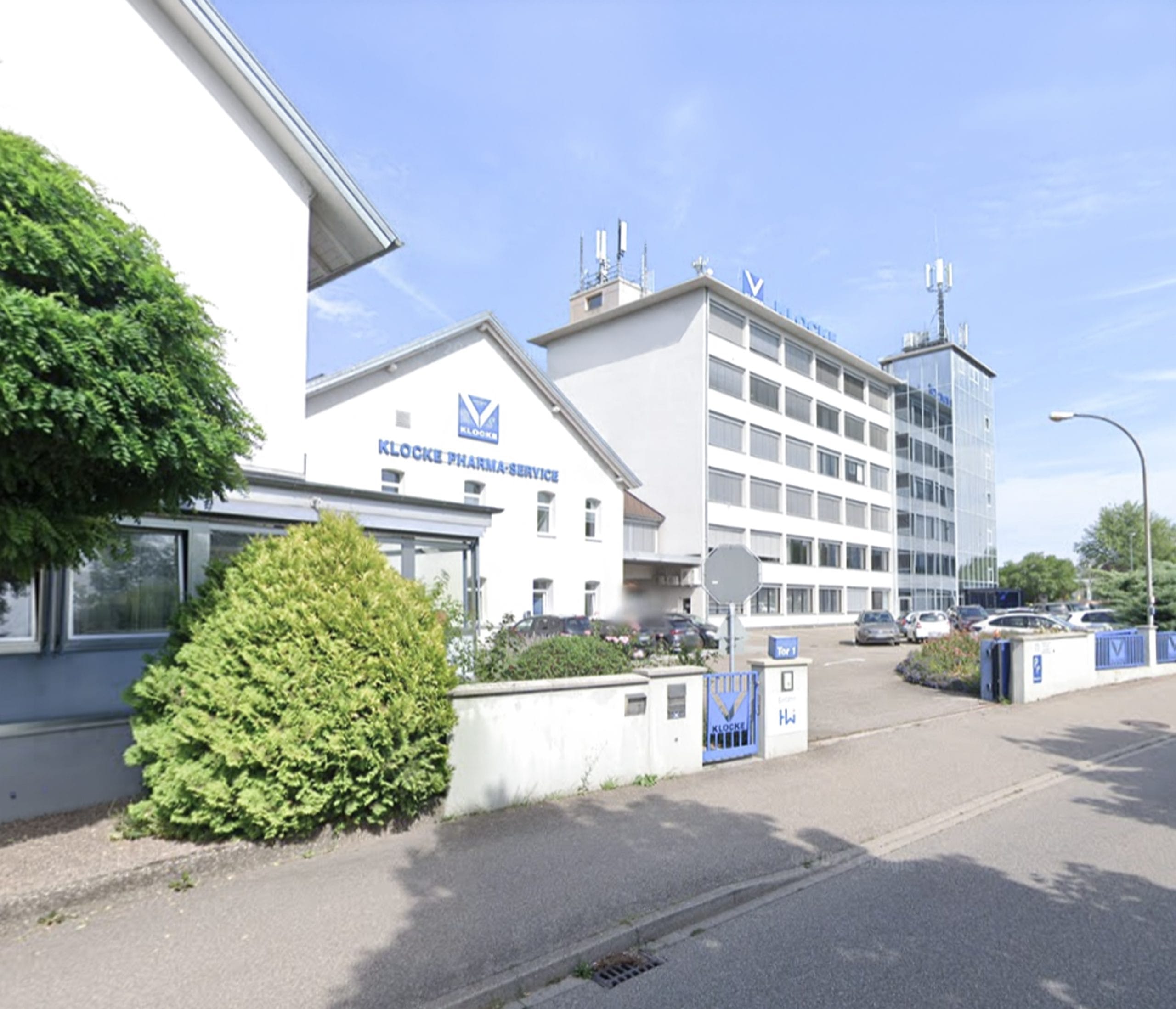
Between fields and mature industrial buildings, the KLOCKE Pharma-Service GmbH site in Appenweier initially appears inconspicuous. There is nothing to indicate how much movement is taking place behind these walls. Only once inside does it become apparent what everything here is designed for: change.
Systems do not stand still for long. They are converted, cleaned and refitted. As soon as one process is completed, the next one begins. Parameters change, recipes are adapted, processes shift. Transitions are not an exception here, but part of daily operations. What is created here does not follow a fixed pattern, but a structure that is designed to accommodate this dynamic.
Paths through production do not show rigid lines, but sequences that are constantly reassembled. Areas interlock, while requirements shift from order to order. Existing systems meet new processes, evolved structures meet current technical requirements. Many things have evolved over the years and are constantly being developed further.
KLOCKE Pharma-Service produces a variety of different products for different customers. Unterschiedlichste Produktionsschritte wie Trocknung, Granulation und Coating werden in kurzen Abständen, je nach Rezeptur, von Charge zu Charge neu verändert. Unterschiedlichste Produktionsschritte wie Trocknung, Granulation und Coating werden in kurzen Abständen, je nach Rezeptur, von Charge zu Charge neu verändert.
Every change means a new beginning, every adjustment has a direct impact on the next steps. Planning does not end with the installation of a line, but continues during operation. What takes place here is not production in the classic sense, but the ability to work constantly under changing conditions. An environment in which diversity is not reduced, but must be mastered. What is the exception in many production environments is part of everyday life in Appenweier. Product changes characterize the entire organization of production here.
With 60 to 70 different products, recipes and parameters change at short intervals. Systems are emptied, cleaned and set up again. Every change means a defined restart under different conditions.
There is no room for maneuver. Cross-contamination must be reliably excluded, regardless of which product was processed previously and which will follow next. Granulation in particular shows how sensitively processes react to changes, while quality must remain constant.
The result is a production system that is not designed for long runtimes, but for the ability to set up processes again and again – and remain stable in the process.
Technology & equipment at a glance
Processes
Different production steps such as mixing, granulating and drying are interlinked and must react flexibly to changing requirements.
Product change
Stock
New systems and processes must be integrated into established structures and adapted to existing spatial boundaries.
Established structures as a framework
Production in Appenweier has grown over the years. Systems have been added, areas expanded, structures adapted – always during ongoing operations. What has been created does not follow ideal planning, but the logic of a site that has developed step by step. This development can be felt in the building. Paths are predetermined, rooms have fixed boundaries, heights cannot be changed. New requirements meet existing conditions. Technology is not created on a greenfield site, but in existing buildings. This has a direct impact on the integration of new systems. Positions are not freely selectable, interfaces have to be adapted, installations become independent projects.
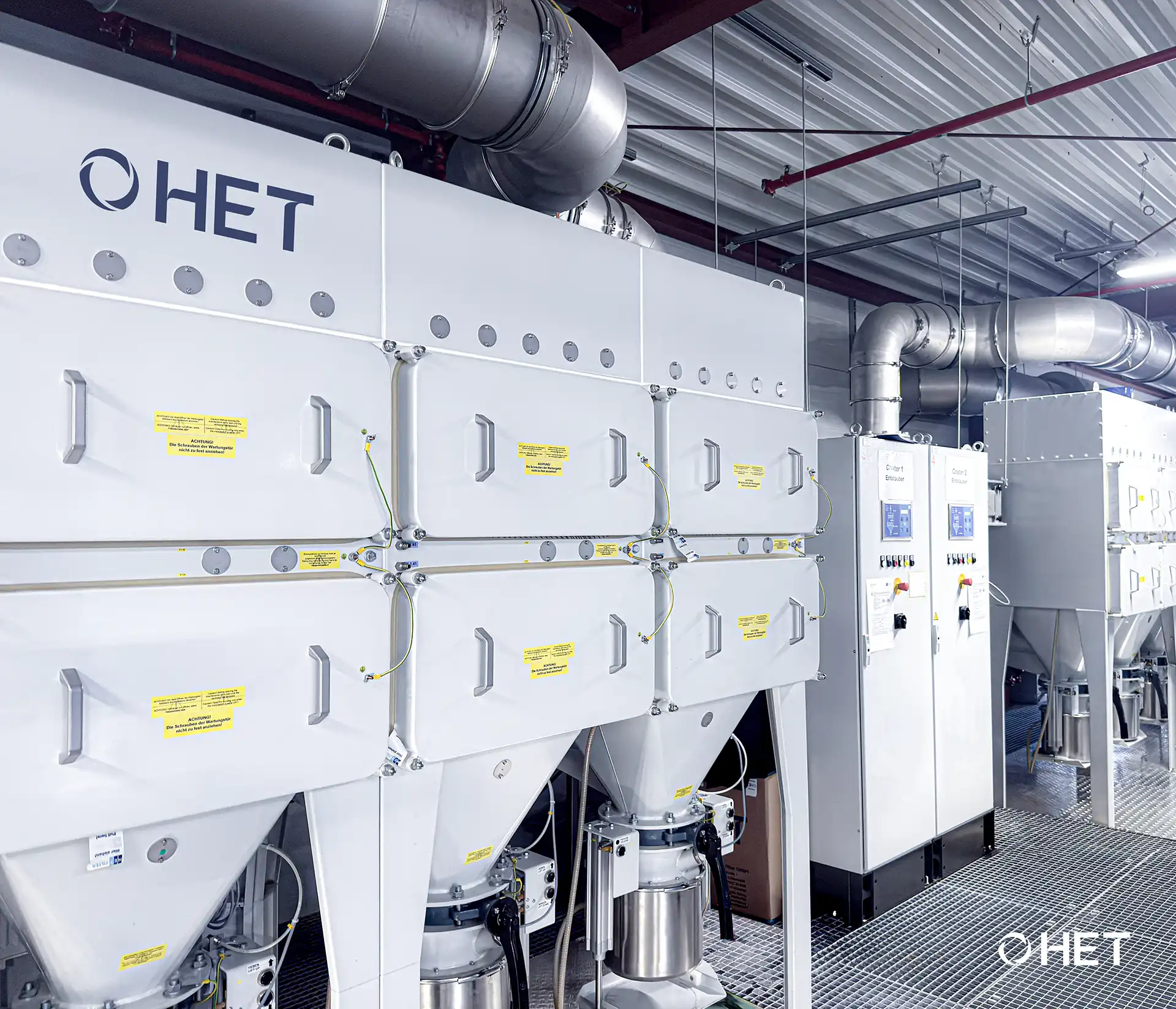
Larger machines in particular require precise planning and external support in order to be integrated into the existing structure. At the same time, existing systems continue to run. The central dedusting system works under increasing load, while processes change and requirements increase. Extensions are possible, but not arbitrary. Every adaptation takes place within a framework that has already been defined. New solutions are therefore not created independently of the existing system, but within an existing system. Adaptations must fit into existing structures and at the same time accommodate increasing requirements. It is precisely this interaction that shows how resilient and flexible a production system actually is.
Filtration as the key to stable production
With increasing product diversity and increasing system loads, one system is becoming increasingly important: dedusting. What has worked reliably for a long time is being re-evaluated under changing conditions. Higher dust quantities, frequent product changes and different material properties mean that filtration no longer just runs along, but is actively involved in shaping it. The requirements do not arise in isolation, but directly in the process. This development is particularly evident in granulation. Fine dusts are produced continuously, sometimes with sticky or difficult-to-handle properties. They must be reliably captured, separated from the air flow and removed from the system. At the same time, these properties change from product to product. What is stable in one process must be adapted in the next.
This shifts the focus from pure separation to the entire filtration process chain. Air routing, capture points, filter media and cleaning mechanisms must be coordinated with each other. Small deviations can have a direct impact on operation, be it through pressure losses, inadequate cleaning or increased maintenance costs. Added to this is the dynamic nature of product changes. Filters are not only stressed during operation, but also in the cleaning cycles between batches. Particularly with products containing sugar, cleaning becomes a separate process step that requires time, care and the right system design. Filters are changed, cleaned or adjusted, depending on the product in question. At the same time, these requirements have a direct impact on the organization of production. Downtimes are extended if cleaning processes are not optimally adapted to the filter technology. Operators have to intervene, processes are interrupted and interfaces between the system and filtration become more prominent. What is intended as a supporting system thus becomes an active part of daily operations.
Integration into the existing infrastructure also plays a key role. The central dust extraction system works under increasing load, while at the same time the requirements for individual processes vary. Air volumes, dust volumes and operating times are not constant, but follow the dynamics of production. Filtration thus becomes a connecting element between the plant, process and building. It not only influences the air quality, but also the availability of the systems, the duration of product changes and the stability of the processes. In an environment like Appenweier, it not only determines the function of individual processes, but also the performance of the entire production process.
Would you like to know how our filter systems can make your processes safer and more efficient?
Get in touch with us
A system that adapts
Against this background, it becomes clear that filtration cannot be designed as a static system. Different products, changing dust properties and frequent changeovers require solutions that can be adapted without losing stability. In Appenweier, the focus was therefore not only on the performance of the dedusting system, but above all on its integration into the existing processes. The decisive factor here is that filtration does not work in isolation, but in direct coordination with the respective systems and their mode of operation.
Capture points are positioned so that dust is captured directly where it is generated. Air flows are guided in a targeted manner to ensure reliable separation without affecting the process itself. At the same time, the systems must be designed in such a way that they can handle different material properties without having to be readjusted every time the product is changed. A particular focus is on cleanability. Filter units and connected systems are designed in such a way that they can be completely emptied and cleaned easily. This not only reduces the time required between batches, but also creates the conditions for reproducible conditions across different products.
Handling also plays a central role in everyday life. Systems must be designed in such a way that operators can use them safely and efficiently, even under time pressure and with frequent changeovers. Maintenance, filter changes and cleaning thus become integral parts of operation and must be designed to be simple and comprehensible. The importance of this adaptability is also evident during operation. Systems must run stably, even if the load changes.
They must allow interventions without interrupting the process and at the same time be robust enough to reliably support daily changes between different applications. The result is not a single filter system, but an interplay of components that fits into the existing structure and at the same time extends its performance. A solution that is not designed for a fixed process, but for the reality of production that is constantly changing.
Consistent results in a variable environment
Production in Appenweier shows how pharmaceutical processes can be operated stably under changing conditions. Diversity, frequent changeovers and established structures are not reduced here, but consciously integrated into the organization of production. The decisive factor here is not a single system, but the interplay of systems, processes and technical design.
In this environment, filtration in particular becomes a central component of process stability. It does not work in isolation, but in direct connection with product changes, cleanability and system availability. This creates a production environment that is not designed for a fixed state, but for the ability to continuously adapt and remain constant.
OTHER INTERESTING TOPICS
Focus on nitrosamines: containment and filter solutions for maximum pharmaceutical safety
Nitrosamines have been a key quality and safety issue in the pharmaceutical industry for several years. The discovery of nitrosamine-containing...
Retrofit containment solutions for existing systems: Optimize safety and compliance economically
Pharmaceutical and fine chemical companies must regularly adapt their production environments to new regulations.Stricter GMP requirements, the...
Digitalization in filtration technology
Digitalization has long since arrived in production-related areas of the pharmaceutical industry - with a clear goal: greater efficiency, safety and...


